


Battle Order × Kaiserreich: WCA/CSA
Aug 13
10 min read
Disclaimer: I am not affiliated with the Kaiserreich team at all.
This is a gallery of military worldbuilding content I've made inspired by the Worker's Congress of America (WCA) in Kaiserreich. This is the new name for the Combined Syndicates of America (CSA).
Kaiserreich is a Hearts of Iron IV alt history mod where the point of divergence is essentially the U.S. not entering the Great War in 1917 and the Central Powers winning, causing a cascade of events including socialist revolutions in the United Kingdom and Metropolitan France. The U.S. not entering World War I is an interesting enough scenario, one that I think could have pretty interesting impacts on the U.S. military. The WCA or CSA is a faction in the Second American Civil War that begins after a contingent Presidential election in Congress during a period of extreme unrest and economic uncertainty. They are the "red" syndicalist/socialist/labor faction in the 2- to 5-way civil war depending on how the player handles things. I assume basically a 5-way civil war but the American Constitutionalist Coalition or PSA and New England are in coalition as true Provisional US Governments.
1. Key Elements
Basic Plot Assumptions —
General MacArthur executes War Plan White, ordering all Army forces to redeploy from their garrisons to the Great Plains and Mid-Atlantic. Some National Guard units comply, although most do not either out of socialist or Longist sympathies (as in the WCA and APG territories) or out of fear of those two factions (as in New England and the ACC).
The Anglo-Canadians cross into New England and New England initially remains out of the Second American Civil War
The 2ACW is long. It goes until at least 1940 to 1941. MacArthur's USMA gets mollywhopped, New England and the ACC are able to stay out of most of it with Anglo-Canadian support, and the WCA and APG grind each other down. How the 2ACW concludes and reconstruction are not considered for this exercise.
The US faction(s) largely stay out of the action in Europe.
Division Designations — As the U.S. does not enter World War I, I am deciding that the establishment of the permanent Infantry Division/Brigade numbering sequence (1st-25th for the Regular Army, 26th-42d for the National Guard, and 76th-102d for the National Army) did not happen. I think you could make a just as convincing argument that a similar sequence would have been established without entering WW1. However, for the obscurity factor I am choosing to continue the division designations planned for before the U.S. entered World War I. The Regular Army had the 1st, 2d and 3d Divisions in the Eastern, Central, and Western Departments; and Cavalry Division in the Southern Department; 3d Cavalry Brigade in the Central Department; and 1st Hawaiian Brigade. The National Guard had 5th-20th Divisions. These divisions were also much larger than what the U.S. took to Europe, based on 3 Infantry Brigades each with 3 Infantry Regiments instead of 2×2 square division. This means fewer divisions overall and individually smaller regiments. As far as New England is concerned in my head canon, this means 6th Division "Empire" would be allotted to New York (instead of the 27th Div and the NY part of the 44th Div) while the 5th Division "Yankee Division" would consist of National Guard units from New England states (instead of the WW1 26th Division and post-WW1 43d Division).
Regiment Designations — As units would not have to be torn apart and redesignated to execute this reorganization, I am also deciding that state designations for regiments remain. For example, instead of there being a 105th Infantry Regiment in the New York National Guard following a national-level sequence, there is a 2d Infantry Regiment, New York National Guard or "2d New York Infantry" or simply "Second New York". I am, however, maintaining a national-level numbering sequence for brigades motivated by some divisions including units from multiple states. For example, instead of New York having 1st, 2d, 3d and 4th Brigades like it did before the U.S. entered WW1, it has the 16th, 17th and 18th Infantry Brigades under the 6th Division. ↑
2. Uniform Graphics
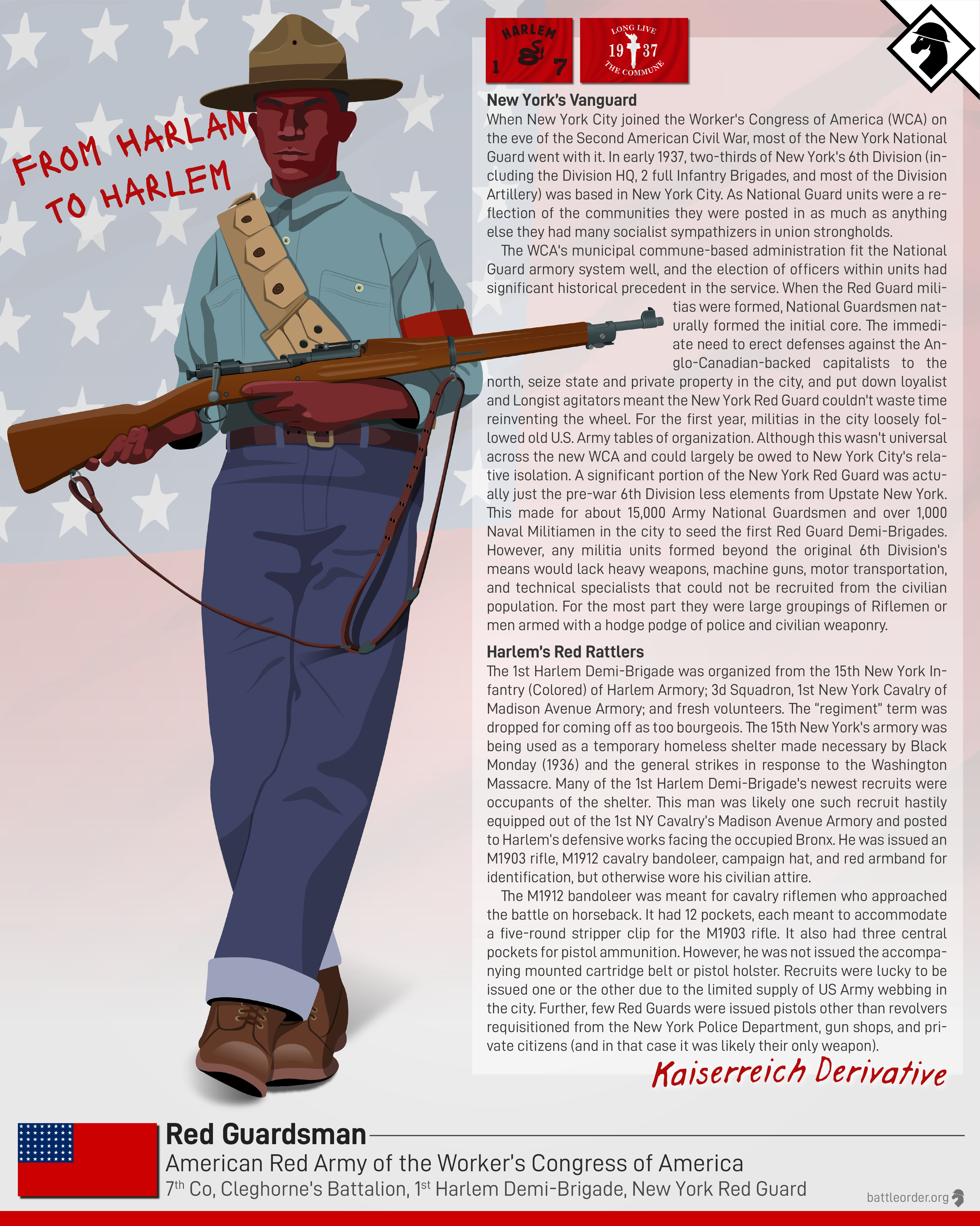
New York Red Guardsman (1937)
Cleghorne's Battalion, 1st Harlem Demi-Brigade, New York Red Guard
When New York City joined the Worker's Congress of America (WCA) on the eve of the Second American Civil War, most of the New York National Guard went with it. In early 1937, two-thirds of New York's 6th Division (including the Division HQ, 2 full Infantry Brigades, and most of the Division Artillery) was based in New York City. As National Guard units were a reflection of the communities they were posted in as much as anything else they had many socialist sympathizers in union strongholds.
The WCA's municipal commune-based administration fit the National Guard armory system well, and the election of officers within units had significant historical precedent in the service. When the Red Guard militias were formed, National Guardsmen naturally formed the initial core. The immediate need to erect defenses against the Anglo-Canadian-backed capitalists to the north, seize state and private property in the city, and put down loyalist and Longist agitators meant the New York Red Guard couldn't waste time reinventing the wheel. For the first year, militias in the city loosely followed old U.S. Army tables of organization. Although this wasn't universal across the new WCA and could largely be owed to New York City's relative isolation. A significant portion of the New York Red Guard was actually just the pre-war 6th Division less elements from Upstate New York. This made for about 15,000 Army National Guardsmen and over 1,000 Naval Militiamen in the city to seed the first Red Guard Demi-Brigades. However, any militia units formed beyond the original 6th Division's means would lack heavy weapons, machine guns, motor transportation, and technical specialists that could not be recruited from the civilian population. For the most part they were large groupings of Riflemen or men armed with a hodge podge of police and civilian weaponry.
The 1st Harlem Demi-Brigade was organized from the 15th New York Infantry (Colored) of Harlem Armory; 3d Squadron, 1st New York Cavalry of Madison Avenue Armory; and fresh volunteers. The “regiment” term was dropped for coming off as too bourgeois. The 15th New York's armory was being used as a temporary homeless shelter made necessary by Black Monday (1936) and the general strikes in response to the Washington Massacre. Many of the 1st Harlem Demi-Brigade's newest recruits were occupants of the shelter. This man was likely one such recruit hastily equipped out of the 1st NY Cavalry’s Madison Avenue Armory and posted to Harlem’s defensive works facing the occupied Bronx. He was issued an M1903 rifle, M1912 cavalry bandoleer, campaign hat, and red armband for identification, but otherwise wore his civilian attire.
The M1912 bandoleer was meant for cavalry riflemen who approached the battle on horseback. It had 12 pockets, each meant to accommodate a five-round stripper clip for the M1903 rifle. It also had three central pockets for pistol ammunition. However, he was not issued the accompanying mounted cartridge belt or pistol holster. Recruits were lucky to be issued one or the other due to the limited supply of supply of US Army webbing in the city. Further, few Red Guards were issued pistols other than revolvers requisitioned from the New York Police Department, gun shops, and private citizens (and in that case it was likely their only weapon).
Notes:
The 15th Infantry Regiment (New York NG) was the original pre-WW1 designation of the 369th Infantry Regiment (Colored) "Harlem's Hellfighters". In my interpretation of the setting I maintain much of the pre-WW1 designation system for National Guard regiments and divisions due to the lack of a mass mobilization.
Harlem's Hellfighters (who in KR wouldn't have fought in WW1 obviously) are also known as Harlem's Rattlers. Their distinctive unit insignia was of a rattlesnake. I repurpose the rattlesnake for the guidons (unit flags) for the Harlem Demi-Brigades of the Red Guard to call back to that.
The use of "demi-brigade" instead of "regiment" is inspired by the French Revolutionary use of the term in the 1790s until 1803 to differentiate themselves from the ancien régime. Aside from regiment just sounding snooty, it was the unit that stored all the important unit heritage and battle honors from the old US and it'd represent a complete shift to new lineages. I also just like the flavor of it and thing making new normally numbered regiments would be a bit boring. The term demi-brigade also implies it is made up of separate battalions. In this case, the soldier's battalion (Cleghorne's Battalion) is named after its current commander. ↑
3. Squad Graphics
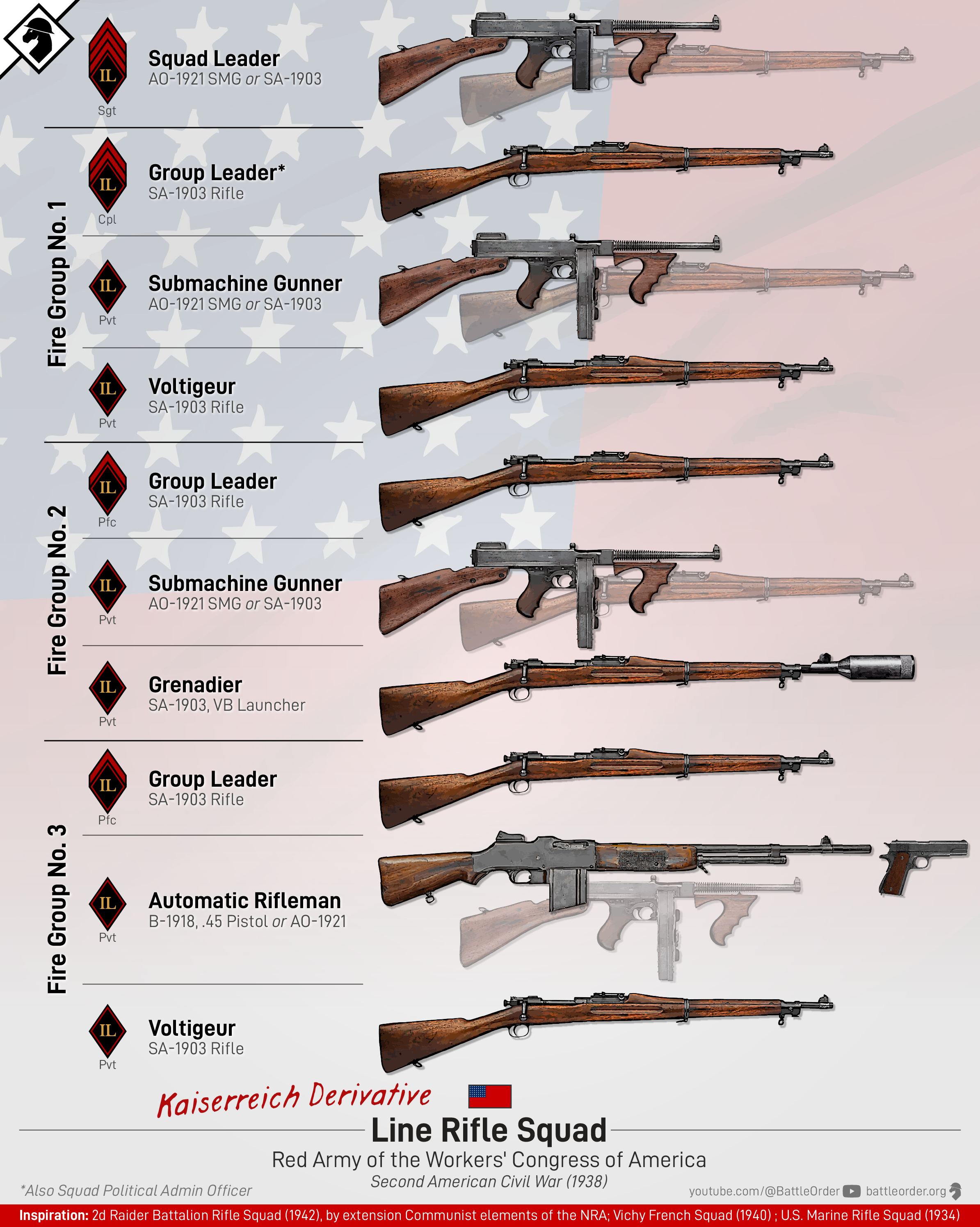
Line Rifle Squad (1938)
This is my concept for a Line Rifle Squad when armed with American arms. This includes mainly M1903s and M1918s inherited by US Army National Guard Armories and Thompson submachine guns pilfered from police stations and gun shops. "Line" in this context includes the National Guard, Organized Reserve and Marine Divisions that were mobilized at the beginning of the Civil War and the Continental Line Divisions/Brigades(?) that are raised throughout the war. Basically, the national-level Regulars juxtaposed by the Red Guard Demi-Brigades that maintain a more militia character.
The squad is organized as a Squad Leader and 3 Fire Groups, each consisting of 3 personnel. Fire Group was the USMC's nomenclature for this sort of subdivision before they adopted Fire Teams.
Each Fire Group is organized around an automatic weapon. At least one would be authorized a Light Machine Gun or Automatic Rifle, like the Chauchat pictured, FM 24/29, Lewis gun, or BAR depending on the unit and its scale of issue. The others would use submachine guns in this role, particularly the M1921 Thompson "borrowed" from private citizens or police departments. They might have one drum to start engagements with and additional stick magazines for ease of carry. If a unit was short of automatic weapons, which would almost be guaranteed at some stages, two fire groups would just be Riflemen while one fire group would serve a single heavier light machine gun such as the M1919, M1918 Marlin, Hotchkiss M1909, aircraft machine guns converted to ground use, etc. Each Fire Group has a leader, possibly elected in some early on but generally an experienced or competent junior man. The most senior Group Leader is also the squad's Political Administration Officer. In addition to typical functions of a second-in-command (managing distribution of ammo, food, etc. with the Platoon Sergeant), they'd also be responsible for monitoring the squad's morale and leading political education sessions and current events lectures. In combat they would also lead the first of the maneuver or "shock" fire groups, which was expected to be the most aggressive.
Each Fire Group would have a Rifleman or Voltigeur (borrowed from the French, as the Americans commonly did) who was in theory the group scout. They also carried spare ammunition for the automatic rifleman. In the case of groups with the Thompson, this would probably just mean a spare drum. However, in the fire group with a light machine gun this would likely be more like 6-12 magazines depending on the model in use (more for the Chauchat, BAR, FM 24/29 and fewer for the Lewis).
The completely made up "scale" system is meant to cope with the variety of arms, ammunition, and other equipment that would be sourced locally, from pre-war stocks, and from foreign aid (mainly from Britain and France). The intent would be to standardize ammunition supply as far up the chain as practical so that at least divisions and separate brigades would not have small sub-units with drastically different ammunition requirements.
The notional scales would be:
Scale A - .30-06 (original National Guard and some Organized Reserve units initially, and increasingly more units as the war progressed)
Scale B - 7.5mm French (Organized Reserve and Continental Line units)
Scale C - 8mm (Organized Reserve and Continental Line units)
Scale D - .303 (Organized Reserve and Continental Line units)
Scale E - Local Procurement (Red Guard Militias and Continental Line units in early mobilization)
This squad organization is inspired primarily by Marine officer Evans Carlson, who in real-life applied a 10-man, 3 "fire group" squad structure in his 2nd Raider Battalion. This structure was near concurrently applied to the Paramarines who collaborated with the Raiders, and would be adapted to the whole Marine Corps with some enlargening in 1944. They basically mixed the two schools of thought at the time (3x3 and 2x4) to create the current 3x4 squad.
Carlson was the far more unorthodox Raider Battalion Commander (1st Raiders commander Merritt Edson is allotted to New England in KR). A key difference between the two is Edson organized his battalion essentially as a stripped back, conventional light infantry unit that could fit on 6 APDs (destroyers converted to carry about a company of special forces) whereas Carlson wanted to engage in unconventional warfare, relatively speaking. In real life, Carlson is said to have been inspired by his contact with Communist Chinese guerillas in 1937-38 who used a 3x3 structure. The real life PLAGF (PRC Army) actually continued to use that 3x3 structure up until their last major reform, and PAVN (People's Army of Vietnam) still uses it to this day.
Whether or not Carlson in KR would have the necessary contact with Communist guerrillas to be inspired by them, as in real-life, is kind of shaky though. He would have missed out on his third deployment to China in 1937 where was an observer of Chinese forces. However, I'm choosing to not think too hard about it. Maybe something during his first two postings to Shanghai or his also very relevant experience in Nicaragua led him to similar conclusions. In his little lore description in KR, his first two postings to China and combat experience as during the Punitive Expedition in Mexico and in Nicaragua are mentioned. Experience during the small wars of pre-WW2 is part of why the USMC was a more serious user of submachine guns in small units before the introduction of the M1 Carbine than the U.S. Army was. It's also why the USMC's pre-war meanderings on small unit organization added more automatic weapons to the squad while the U.S. Army attempted to remove them.
When the civil war fires, WCA starts with a small "Continental Marine Division". Perhaps Carlson's ideas were first implemented there (as he was probably one of its rapidly promoted field grade officers) and then eventually force-wide doctrine after he was made a General.
Although not a primary inspiration, the early Vichy French Metropolitan rifle squad from about August 1940 theoretically had M1921 Thompsons for its Squad Leaders and a Submachine Gunner in addition to the squad's FM24/29 machine gun, which I thought was cool. USMC Rifle Squads in 1934 tables also had a Submachine Gunner in addition to the squad's M1918 BAR. The SMG guy would basically act as a close quarters automatic rifleman, reflecting experience gained in China and Nicaragua.
The ranks I am using are basically adaptations of a later style of French lozenge badges that included both their regiment and rank. Early Soviet branch sleeve badges were also diamond shaped, but I mainly like the look of the French badges. The unit's state of origin is embroidered in the lozenge (Pennsylvania for the Scale C squad and Illinois for the Scale A squad), although I'm sure there would be a lot of variety. To avoid it being just a Cold War French ripoff the chevron count on these is like the classic American system rather than the French. For example, the American Sergeant has traditionally had 3 chevrons while the French Sergeant of the time was either one or two non-subdued chevrons/slashes depending on if they were a conscript or a regular.
The nomenclature of the Thompsons follow what's laid out in the game (AO for Auto-Ordnance, SA for Springfield Armory, WM for White Motors, etc.). ↑






Comments