


Battle Order × Kaiserreich: New England
Aug 13
8 min read
Disclaimer: I am not affiliated with the Kaiserreich team at all.
This is a gallery of military worldbuilding content I've made inspired by New England in Kaiserreich.
Kaiserreich is a Hearts of Iron IV alt history mod where the point of divergence is essentially the U.S. not entering the Great War in 1917 and the Central Powers winning, causing a cascade of events including socialist revolutions in the United Kingdom and Metropolitan France. The U.S. not entering World War I is an interesting enough scenario, one that I think could have pretty interesting impacts on the U.S. military.
I don't consider myself much of an alt history aficionado and don't have strong opinions about Kaiserreich itself, but I do find it to be a useful vehicle for some interesting alt history worldbuilding without having to come up with the lore myself. I more or less respect the bones of the plot as of the last time I played it (it's probably now unrecognizable to those who are more familiar with its earlier days), but ignore much of the flavor text with regards to military units to allow for my own spin. I gather much of the military flavor text (e.g. division names) is limited by the mechanics of the game itself and more inspired by post-WW1 developments than pre-WW1, and anything below the division-level is irrelevant mechanistically anyway, so I don't feel this is stepping on too many toes.
1. Key Elements
Basic Plot Assumptions —
General MacArthur executes War Plan White, ordering all Army forces to redeploy from their garrisons to the Great Plains and Mid-Atlantic. Some National Guard units comply, although most do not either out of socialist or Longist sympathies (as in the WCA and APG territories) or out of fear of those two factions (as in New England and the ACC).
The Anglo-Canadians cross into New England and New England initially remains out of the Second American Civil War
The 2ACW is long. It goes until at least 1940 to 1941. MacArthur's USMA gets mollywhopped, New England and the ACC are able to stay out of most of it with Anglo-Canadian support, and the WCA and APG grind each other down. How the 2ACW concludes and reconstruction are not considered for this exercise.
The US faction(s) largely stay out of the action in Europe.
Division Designations — As the U.S. does not enter World War I, I am deciding that the establishment of the permanent Infantry Division/Brigade numbering sequence (1st-25th for the Regular Army, 26th-42d for the National Guard, and 76th-102d for the National Army) did not happen. I think you could make a just as convincing argument that a similar sequence would have been established without entering WW1. However, for the obscurity factor I am choosing to continue the division designations planned for before the U.S. entered World War I. The Regular Army had the 1st, 2d and 3d Divisions in the Eastern, Central, and Western Departments; and Cavalry Division in the Southern Department; 3d Cavalry Brigade in the Central Department; and 1st Hawaiian Brigade. The National Guard had 5th-20th Divisions. These divisions were also much larger than what the U.S. took to Europe, based on 3 Infantry Brigades each with 3 Infantry Regiments instead of 2×2 square division. This means fewer divisions overall and individually smaller regiments. As far as New England is concerned in my head canon, this means 6th Division "Empire" would be allotted to New York (instead of the 27th Div and the NY part of the 44th Div) while the 5th Division "Yankee Division" would consist of National Guard units from New England states (instead of the WW1 26th Division and post-WW1 43d Division).
Regiment Designations — As units would not have to be torn apart and redesignated to execute this reorganization, I am also deciding that state designations for regiments remain. For example, instead of there being a 105th Infantry Regiment in the New York National Guard following a national-level sequence, there is a 2d Infantry Regiment, New York National Guard or "2d New York Infantry" or simply "Second New York". I am, however, maintaining a national-level numbering sequence for brigades motivated by some divisions including units from multiple states. For example, instead of New York having 1st, 2d, 3d and 4th Brigades like it did before the U.S. entered WW1, it has the 16th, 17th and 18th Infantry Brigades under the 6th Division. ↑
2. Uniform Graphics
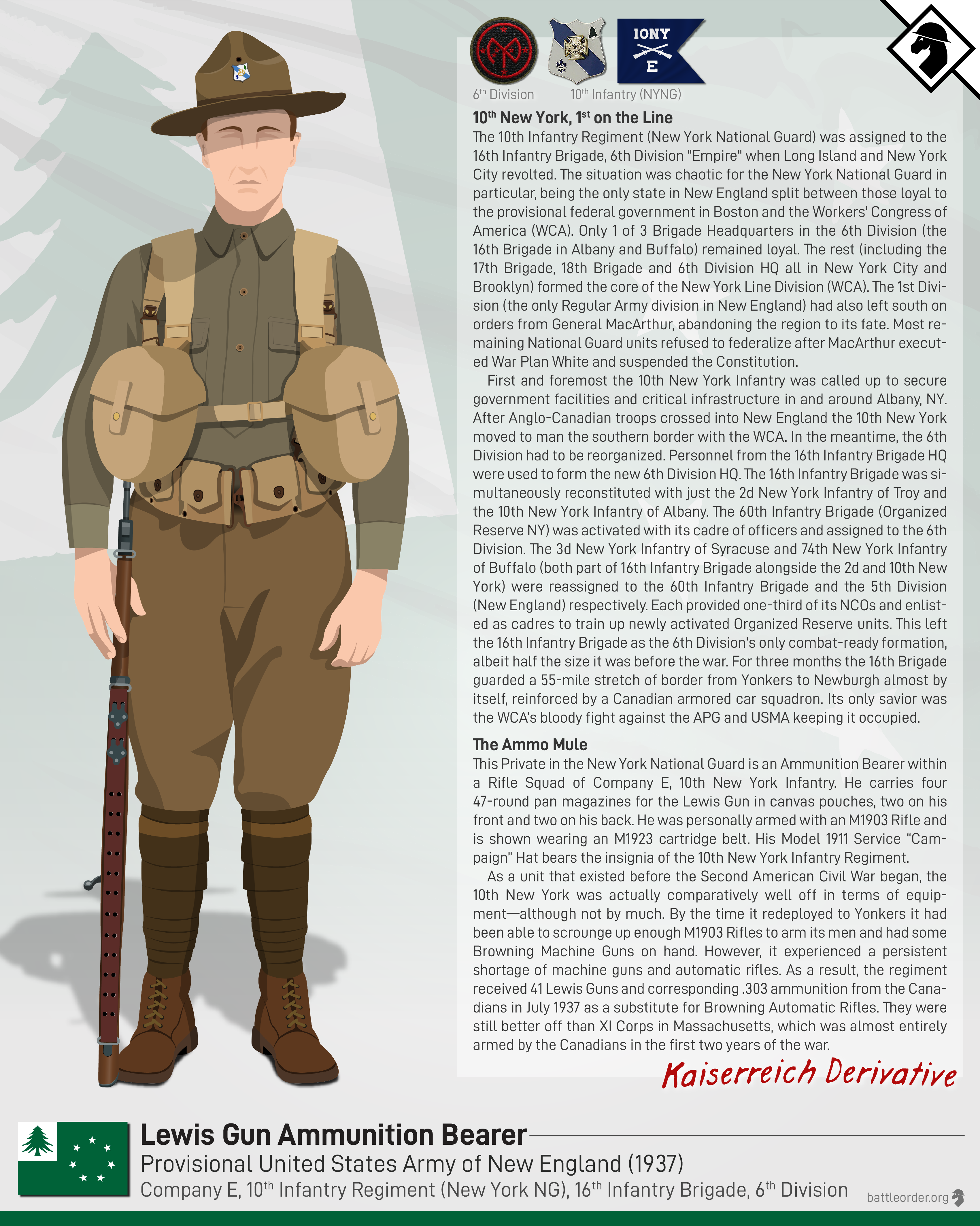
Lewis Gun Ammunition Bearer (1937)
10th New York Infantry, 16th Infantry Brigade, 6th Division
An example of a relatively well-equipped New York National Guardsman (although still in a 1910s era uniform) acting as an Ammunition Bearer in a Rifle Squad. This is fairly representative of a real Interwar National Guardsman, with the exception of the Lewis Gun Magazine pouches hanging over his front (and back out of picture). The assumption is even the well-equipped units in New England that existed prior to the 2ACW would be facing shortages of machine guns and automatic rifles. The 10th New York Infantry here received 41 Lewis Guns with .303 ammo from the Anglo-Canadians to substitute its missing Browning Automatic Rifles.
The expository text talks about the chaos in the NYNG because New York City and Long Island rebel and join the Workers' Congress of America (WCA). In my interpretation, most of the 6th Division goes over to the WCA (Division HQ, 2 of 3 Infantry Brigades, 6 of 10 Infantry Regiments, and 2 of 3 Field Artillery Regiments). This leaves its 16th Infantry Brigades in Upstate New York and its 2d, 3d, 10th and 74th New York Infantry Regiments as the division's only remaining combat units. The 16th Infantry Brigade's HQ becomes the new HQ of the 6th Division, a new 16th Infantry Brigade HQ is formed, the 2d and 10th New York Infantry stay with the 16th Brigade and move to guard the border with the WCA between Yonkers and Newburgh, and the 3d and 74th New York Infantry are transferred and used to help stand up the 60th Infantry Brigade (Organized Reserve New York) and units of the 5th Division (New England National Guard). ↑
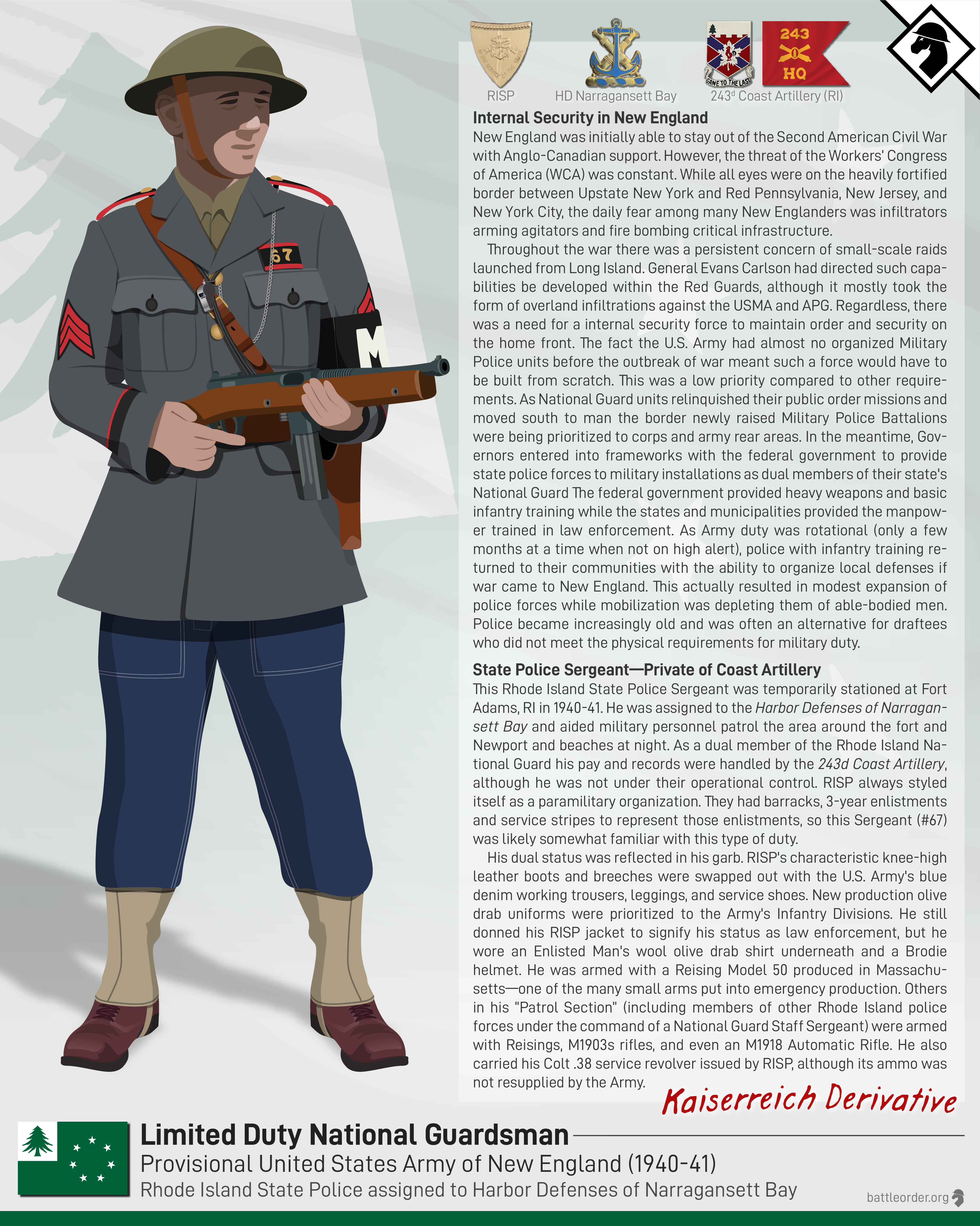
Limited Duty National Guardsman (1940-41)
Rhode Island State Police assigned to Harbor Defenses of Narragansett Bay
As New England scrambled to mobilize as a bloody war waged to their south, sourcing the manpower to conduct internal security duties further from the border became a matter of great concern. The threats of civil disorders, WCA infiltrators, and amphibious raids launched from Long Island (Evans Carlson was a WCA general after all) were particularly troubling. Military police forces were basically a non-factor in the interwar U.S. Army and any new MP units would likely be prioritized to securing corps and army rear areas and guarding military prisons.
In the meantime, Governors entered into a framework with the provisional federal government in Boston. Under this framework, state police would be dually enlisted in the National Guard for MP-type roles around military installations on a rotational basis. A key factor was they were enlisted in their own state's National Guard to keep the administration in-house and for pride reasons. In return, the federal government would subsidize the salaries of their officers (taking some financial burden off of the state governments), provide basic infantry and heavy weapons training that the officers could take back to their communities should war ever come to New England, and take some operational load off of municipal police departments who were being drained of able bodied men for mobilization.
This example is a Sergeant in the Rhode Island State Police (RISP), an organization known for being somewhat paramilitary. He has been enlisted as a Private administratively assigned to the 243d Coast Artillery Regiment (Rhode Island NG) but under the operational control of the Harbor Defenses of Narragansett Bay. His general duties are patrolling in the area around Fort Adams and Newport, especially the beaches at night to counter amphibious raids or infiltration. He is armed with an M50 Reising submachine gun put into emergency production in Massachusetts to bolster New England's limited supply of automatic weapons. New England was basically the heart of weapons manufacturing in real-life, and in Kaiserreich was probably only rivalled in this regard by the WCA and its Steel Belt. He also has a holster with a Colt .38 revolver issued by RISP. Its ammo wasn't resupplied by the Army but he kept it and a personal supply for when interacting with the civilian population around Newport. ↑
3. Squad Graphics
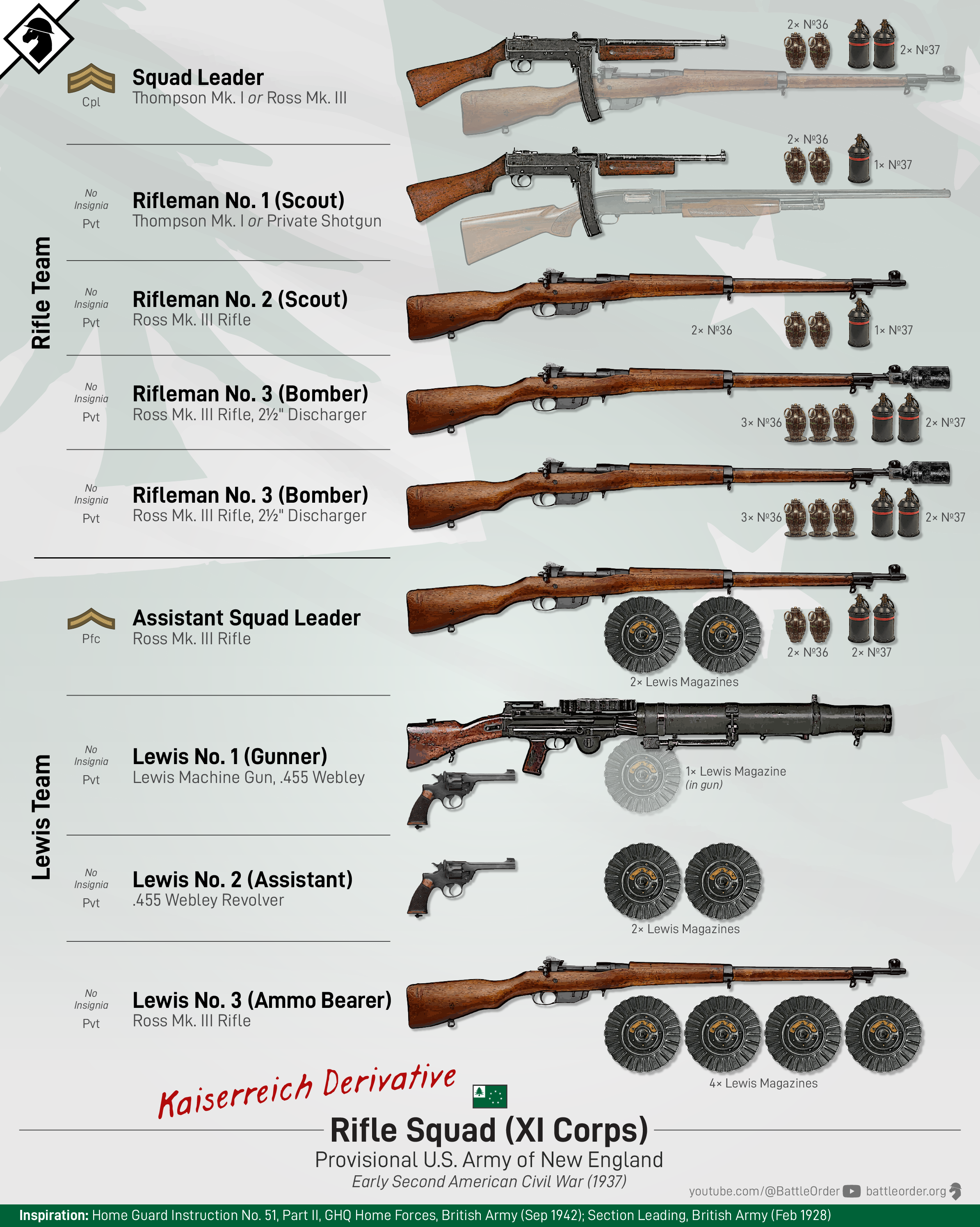
XI Corps Rifle Squad (1937)
While New England was home to large arms manufacturers such as Springfield Armory, Winchester, and Savage Arms, I assume production of all sorts of ordnance and quartermaster items would take time to spool up. The 2ACW starts in the midst of an unmitigated economic calamity and they're missing out on much of the arms reserve manufactured during the real-life World War I. Further, I assume the under strength National Guard and Regular Army units that came under New England would be priority for this domestic production and pre-war stocks. However, immediate mobilization of inactive units would likely have been heavy recipients of both equipment and advisers from the Entente.
In real life, XI Corps was a part of the Organized Reserve with units of unpaid cadre officers in Massachusetts, Connecticut, New Hampshire until 1933. In my interpretation, XI Corps is one of the Organized Reserve groupings activated to be filled with mobilized draftees. Due to the dire equipment situation, XI Corps is almost entirely armed and supplied by the Anglo-Canadians for the first couple years of the war, from weapons to uniforms (they even turn Canadian rank chevrons upside down to mimic American chevrons).
This Rifle Squad is armed with a mix of Thompson Mk. I submachine guns (the real BSA Thompson which in Kaiserreich lore is used by the Anglo-Canadians), Ross Mk. III Rifles (the Anglo-Canadian reserve rifle, the SMLE successor was not even in mass production yet), .455-inch revolvers, and the Lewis Gun. Commonwealth terms were adapted to American sensibilities (like "Rifle Squad" instead of "Section", and use of the word "Team") but really this organization was a mixture of the peacetime U.S. Army squad and the next Canadian infantry section leading pamphlet in the works. It also has elements of Canadian Home Guard doctrine, with a requisitioned hunting shotgun for the scout and dedicated hand bombers. ↑
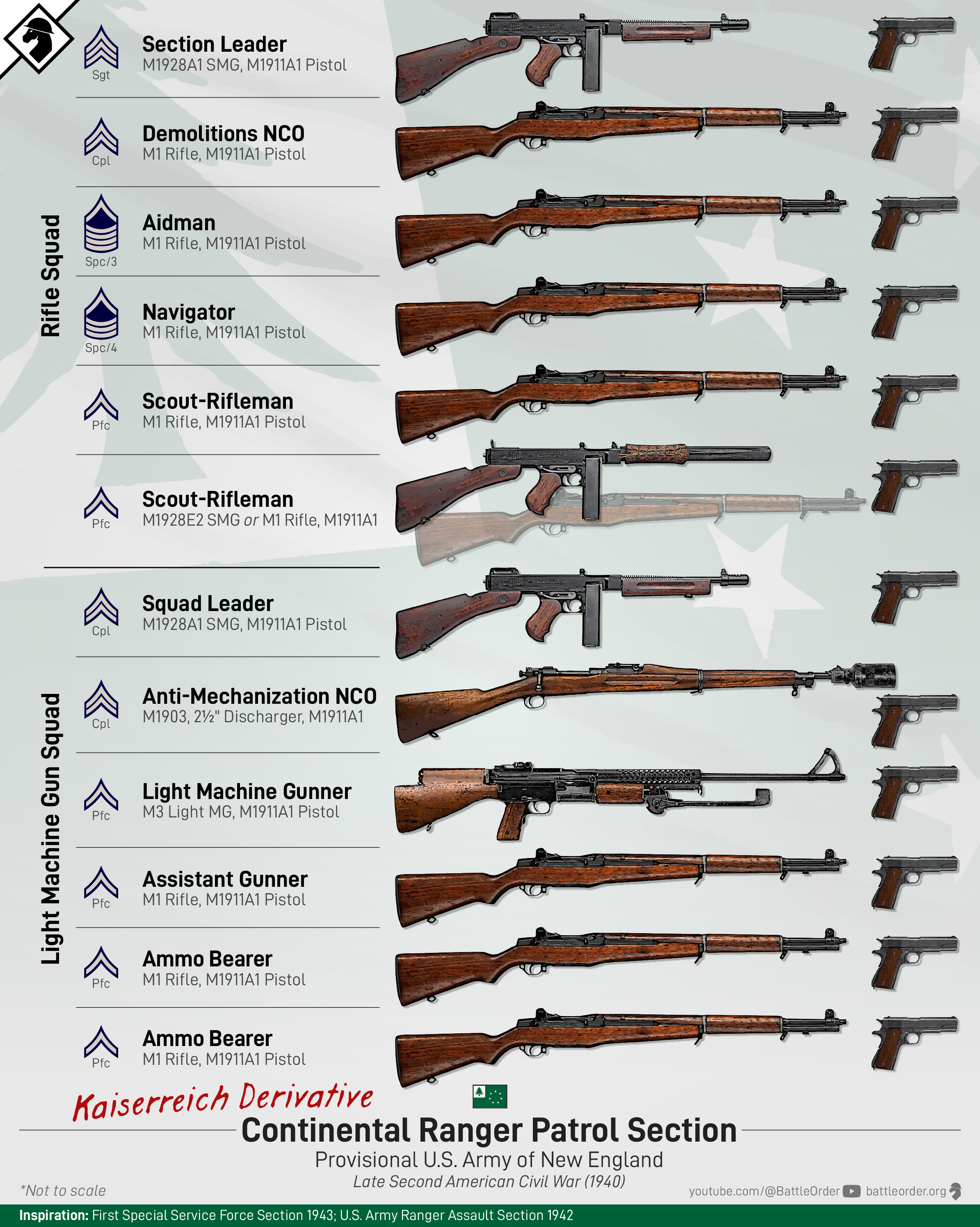
Continental Ranger Patrol Section (1940)
As the 2ACW dragged on and the political and manufacturing situations improved in New England, its Provisional U.S. Army began to form special purpose units inspired by the Anglo-Canadian Commandos. One of these units was the Continental Rangers, who were raised to conduct infiltrations and raids behind WCA lines. Primarily inspired by the real life U.S. Army Rangers and U.S.-Canadian First Special Service Force, they are particularly well endowed with the newest in weaponry.
This "Patrol Section" (so named for its role conducting long-range patrols) are equipped with the M1 Rifle designed by Canadian-American firearms designer Jean Garand. While the rest of New England's Army was likely armed with M1903 bolt-action rifles and a residual amount of Canadian arms by 1940, the Continental Rangers got first dibs on the new semi-automatic.
The section machine gun was the M3 Light Machine Gun (the M1941 Johnson). Melvin Johnson was a native of Boston so his designs would be fair game later in the war for New England and the ACC, who were aligned with one another. I think they would probably be limited to special forces units like these though, similar to how they were limited to Paramarines, Marine Raiders, and the FSSF in real life. I am pulling the finalized Johnson design a year or two earlier into the timeline, but I gather imminent total war at home may provide greater motivation than the peacetime 1930s US.
An Anti-Mechanization NCO is armed with an M1903 mounting a British 2.5" cup discharger for firing anti-tank rifle grenades. In real life the M1903 mounted the French VB and later M1, but since the Anglo-Canadians would likely have been New England's main supplier of AT grenades or AT grenade designs at least they'd probably just rig the M1903 for this purpose.
M1928A1 Thompsons, produced in Connecticut and New York, are also heavily represented. The M1928E2 is an integrally suppressor model optionally allotted to one of the Scout-Riflemen for the purpose of quietly eliminating sentries. ↑
4. Maps
Operation Stellar (June 1937)
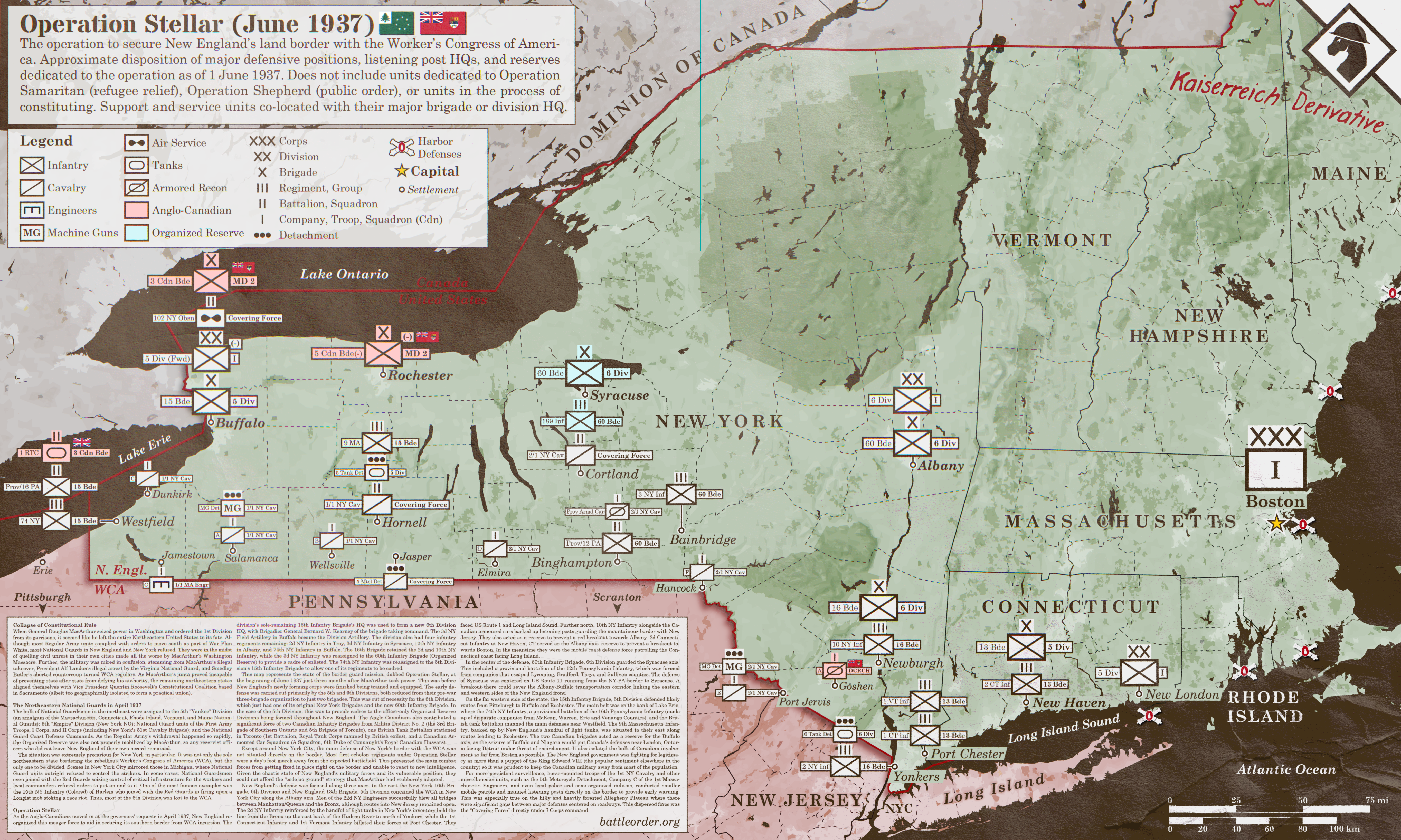
This map depicts the initial disposition of forces deployed to New York's southern border with the Worker's Congress of America by the provisional US Government in Boston. It assumes most of the remaining New York National Guard and portions of the New England National Guards that already existed when the 2nd American Civil War began would form most of the initial defenses. The Anglo-Canadian troops guaranteeing their initial non-participation are also pictured. ↑






Comments