


Motorized Rifle Platoon of the 9th Infantry Division (1987)
Jul 13
3 min read
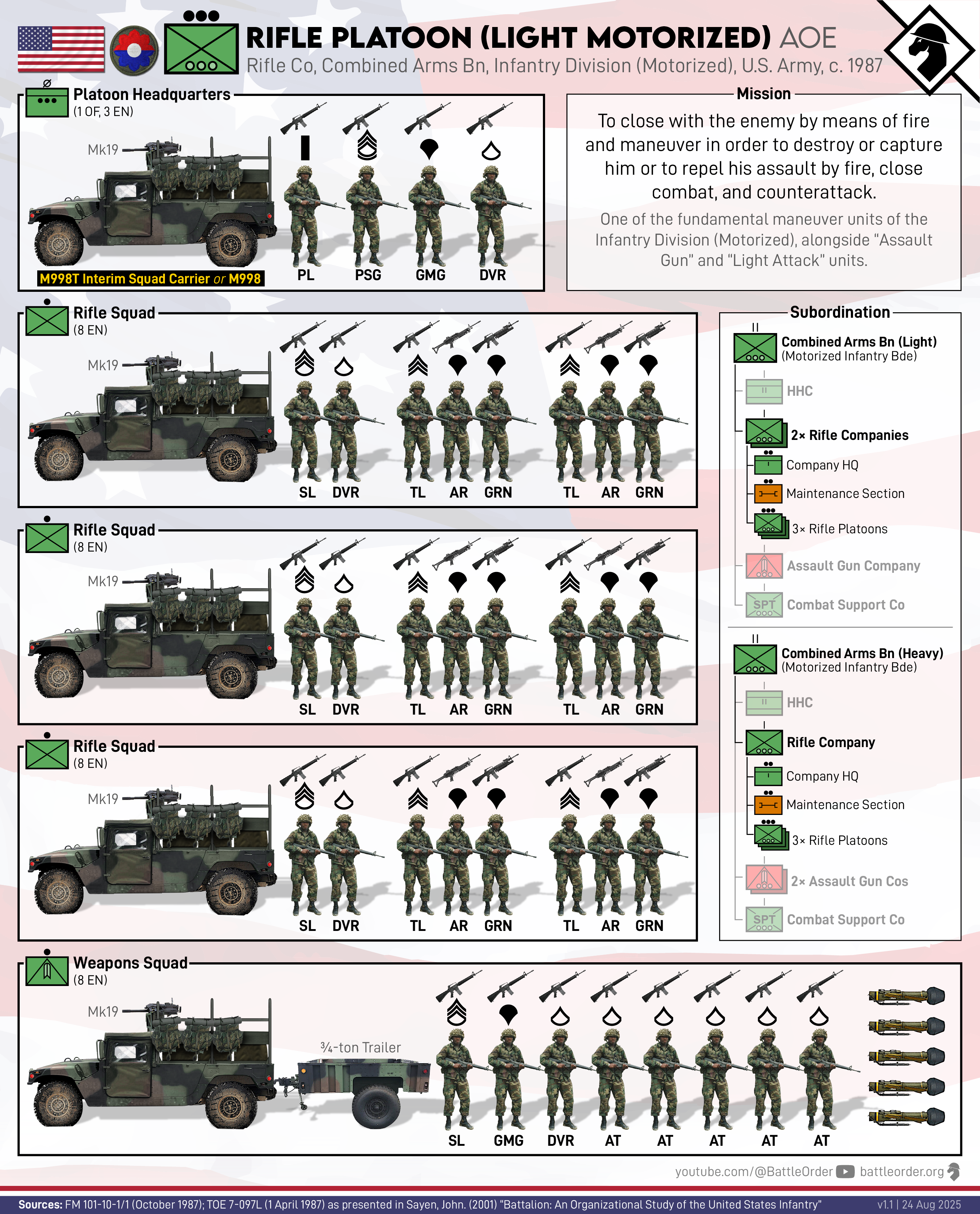
Before the 101st got stripped down Chevy Colorados the 9th Infantry Division was riding around in Humvee utes
By 1987 the mission of the 9th Infantry Division was “to rapidly deploy to a contingency area, establish or expand a lodgment, and defeat enemy armed forces ranging from light infantry to tank and motorized forces.” The Infantry Division (Motorized) was also intended to be particularly suitable for desert and arid mountainous terrain where forces are required to maneuver over extended distances. To do this, it was outfitted with light vehicles that were readily air transportable. The Rifle Company of the Combined Arms Battalion only had HMMWVs, not deuce-and-a-half.

Pictured here, the 9th Infantry Division's Rifle Platoon (Light Motorized) is equipped with five M998T Interim Squad Carriers. 135 were modified for the 9th Infantry Division (Motorized). They had a roll-over protection kit, troop seats with seat belts, and (presumably) a mount for a Mk19 Mod III. The division's TO&E went extremely heavy on the Mk19 to the detriment of other common vehicle mounted weapons, such as the M2 caliber .50 heavy machine gun or M60. I figure this is because the Army wanted to figure out how they were going to employ the Mk19 as it wasn't fielded in other ground units so the 9th Infantry Division would be the testbed.
Within the division's Combined Arms Battalions, light motorized infantry used the M998 as an interim squad carrier for an 8-man squad (9 men when account for the 1 attached Dragon Gunner in the Weapons Squad). It honestly wasn't that good of a squad organization by U.S. Army standards when accounting for the men that'd be left behind to secure the vehicles and/or man their weapons in support, but that's neither here nor there. There was a theoretical requirement for 63 HMMWV squad carriers per Heavy Combined Arms Battalion and 81 per Light Combined Arms Battalion. They originally envisioned the new Motorized Infantry Division concept to have 5 heavy and 2 light CABs, although by 1989 they only had 2 of each.
In January 1985, 135 M998s were approved to be modified at Tooele Army Depot as ISCs. This is based on reports from the 9th Infantry Division Papers that were on USAHEC before they did their redesign (Collection ID 20183030MN if anyone has them, I unfortunately didn't download them before they got taken down). These modifications occured in the second-half of 1986, with the fielding goal being 1st Quarter 1987. M882 CUCVs (GM pickup trucks) fitted with seatbelts and roll bars (modifications that saved lives during field exercises) were originally used during early unit conversions, but for general fielding the CUCV was identified as not fit for purpose in a December 1984 memo.
However the M998 HMMWV wasn't perfect either. For instance, it had no weapons mount for the Mk 19 Mod III that was a cornerstone system of 9ID. They also wanted there to be troop seats with seat belts, but for that they'd also need rollbars. It also had a 2400 lbs carry capacity, but an 8-man squad with the desired vehicle modifications was projected to be 3000 lbs. To rectify this, "heavy" M998s were authorized for limited production, with the first 72 going to 7th Infantry Division (Light)'s DIVARTY for evaluation and the following 135 going to 9ID. I'm not sure if additional M998Ts were made, but 9ID began inactivation process in 1990 anyway.
The division also used regular M998s without roll cages or weapons mounts in this role as late as a 1988 NTC rotation. As of February 1988, only 1 of 2 motorized brigades was equipped with the ISCs which basically lines up with 135 procured. By that time the division's 3rd brigade was a normal ARNG mechanized round-out brigade (81st Inf Bde WA ARNG).
The division was meant to be a first-in armor defeating capability. They went heavy on the TOW missiles, with 27 TOWs per Light Attack Battalion, 40 per Combined Arms Battalion (Heavy) and 20 per Combined Arms Battalion (Light). In the Combined Arms Battalions—which had infantry sorts of missions but motorized—TOWs were basically a surrogate for the future M8 AGS that didn’t come to pass before the 9th Infantry Division was inactivated anyway. TOWs in Light Attack Battalions—which were basically cavalry-type units meant for highly mobile attacks by fire—were initially meant to be mounted on Fast Attack Vehicles (dune buggies), but by 1987 TOEs were also TOW HMMWVs.







Comments