


USMC C-Series Rifle Squad of the 1980s: 11-man and Short-Lived
Jun 29
3 min read
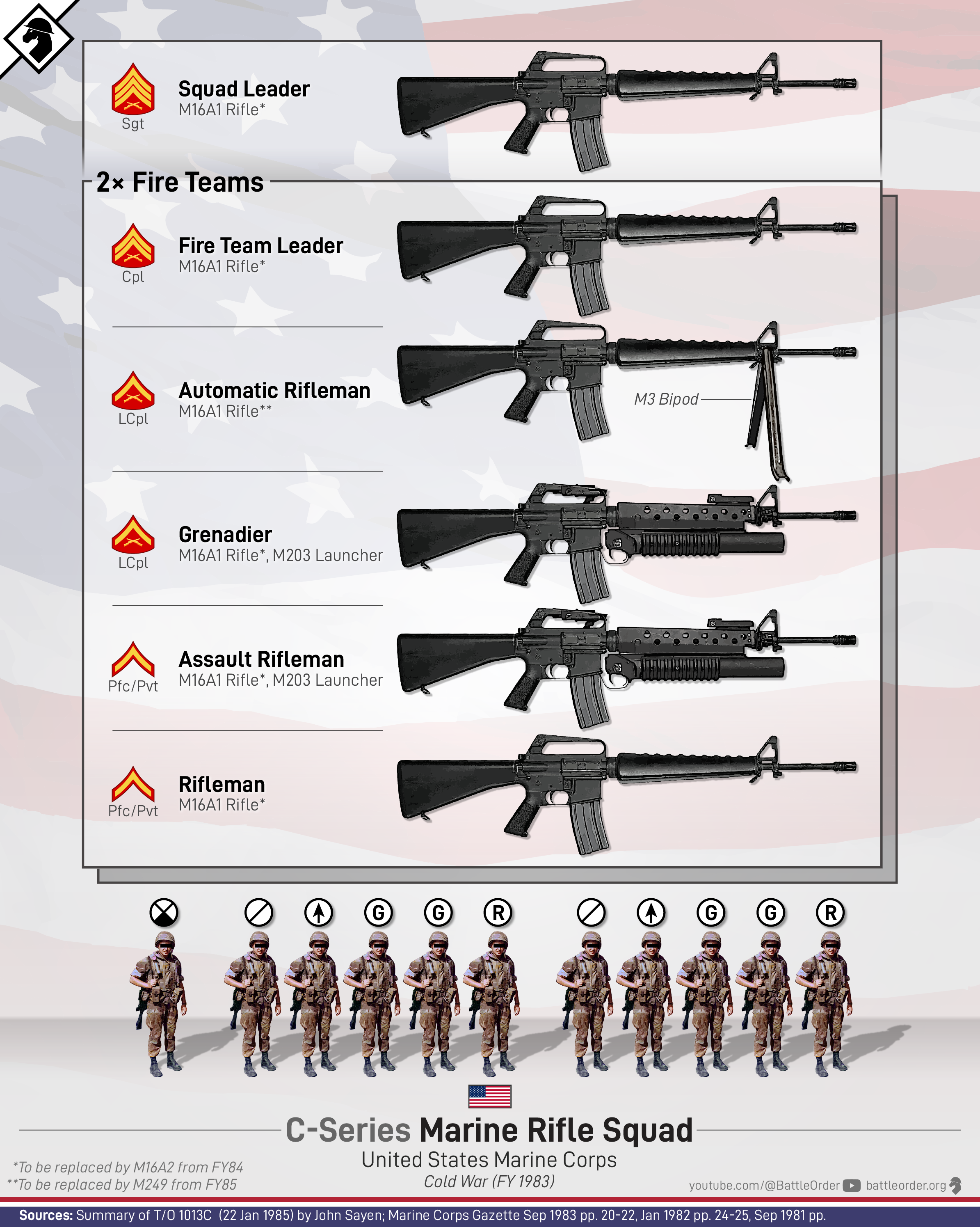
When journalists or even Marines talk about the current 13-man Rifle Squad consisting of 3 teams, they often say that it has been the Marine's squad organization since World War II. This is more or less true, it has served continuously since 1944 if you include the era of the M79 Grenade Launcher where the squad had 14 men. However, in the early 1980s the U.S. Marine Corps briefly implemented an 11-man Rifle Squad organization in some units. The main incitation was the need to reduce the Marine Corps' T/O strength to cope with shortages while maintaining its 27-active battalion force. Among other major changes to the Infantry Battalion, the Rifle Squad fell victim to nickel and diming.
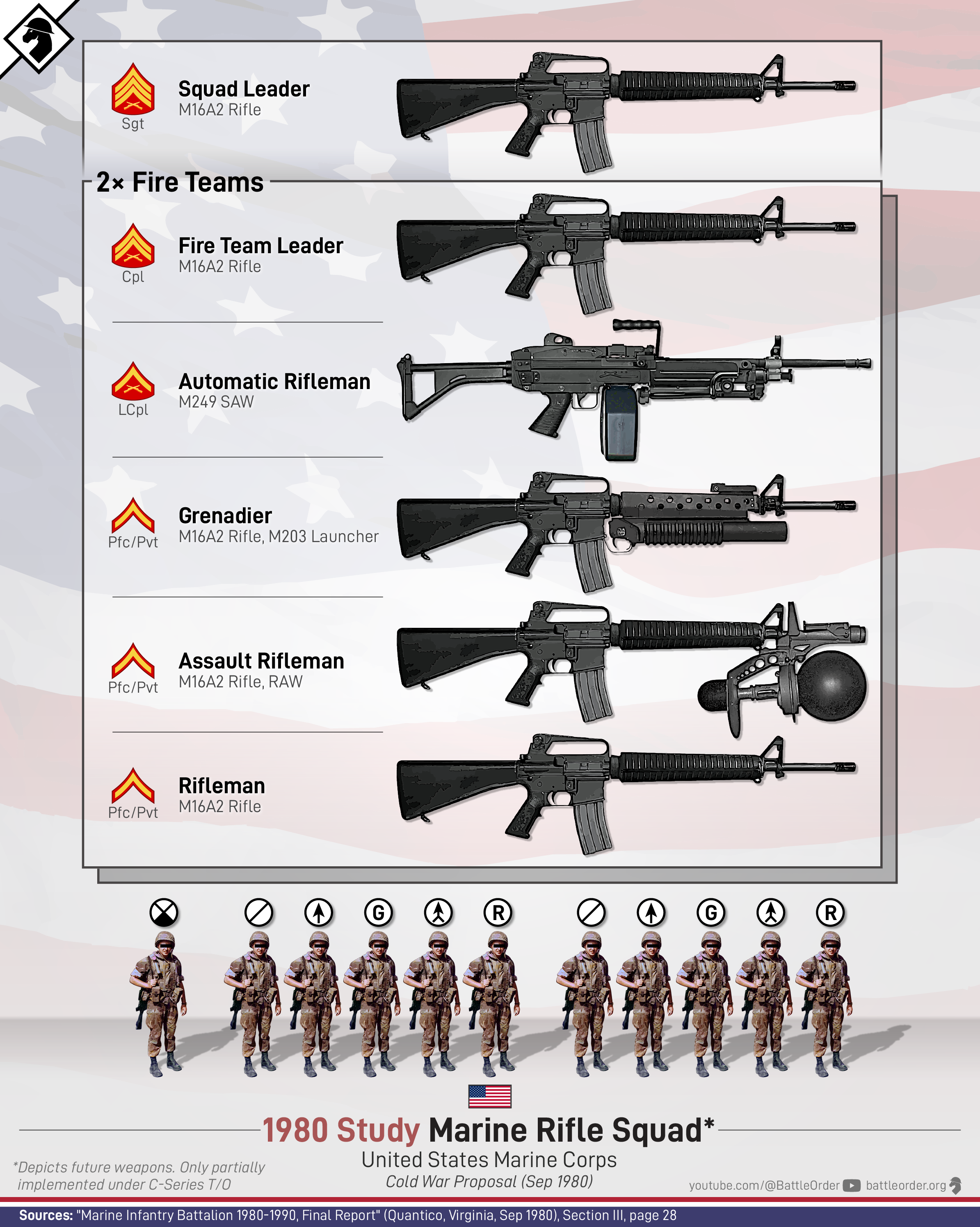
The C-series tables of organization were based on a 1980 study to reorganize the Infantry Battalion. The rationale was to increase firepower while decreasing manpower. The original 13-man squad based on 3 fire teams was replaced by a 11-man squad based on 2 fire teams. Each fire team consisted of a Fire Team Leader, Automatic Rifleman (to be re-equipped with the M249 beginning FY85), 2 Grenadiers (1 of which was meant to be re-equipped with a Rifleman's Assault Weapon in the future per the 1980 study), and 1 Rifleman.
3rd Battalion, 6th Marines were the first to reorganize on the new tables in October 1982 and at least 2nd Battalion, 8th Marines deployed to Lebanon in late 1983 on them as the ground combat element of 22d MAU (Frank, page 116). However, the C-series organization was not popular and not fully adopted before it was replaced in FY86-88 by the more conventional E-series. In the meantime, commanders were authorized to adopt an interim squad organization of 1 Squad Leader and 3 fire teams of 3 men each before they converted.

I joke that it is basically a Marine officer's rite of passage to write a Marine Corps Gazette article suggesting their own radical ideas for the rifle squad organization that never changes, but it's almost true. Pictured here was the idea of Commandant Robert B. Neller (then Captain) to combine the 11-man and old 13-man squad organizations into a new 1 + 2×6-man team squad reminiscent of recent rejected experiments.
The 1980 Infantry Battalion Experiment Squad
In the land of theory though, this C-Series squad was actually a compromise of what the 1980 Infantry Battalion Study called for versus the equipment that was actually fielded. The C-series T/O was replaced very early on into the M16A2 and M249's procurement, so the M16A1 was all that was available. Additionally, the 1980 study called for a weapon that was not fielded: the Rifleman's Assault Weapon (a 1 kg HESH warhead in big ball form). Rather than two Grenadiers per team, they were meant to have one M203 Grenadier and one "Assault Rifleman" with the RAW. When I posted this on Facebook a while back, some Marines from the early 80s confirmed that they were trained on a structure using this notional name. The RAW was actually a U.S. Army program that the Marines were monitoring, but the rest of their recommendations basically got adopted. In the interim the Assault Rifleman was actually equipped with an M203 for 4 per squad.
This notional squad, including notional M16A2s, M249s and the RAW, is pictured below:







Comments