


U.S. Airborne Rifle Squad of the Late-1990s: M4 Carbines, Optics & Lasers
Apr 6
3 min read
Updated: Apr 9
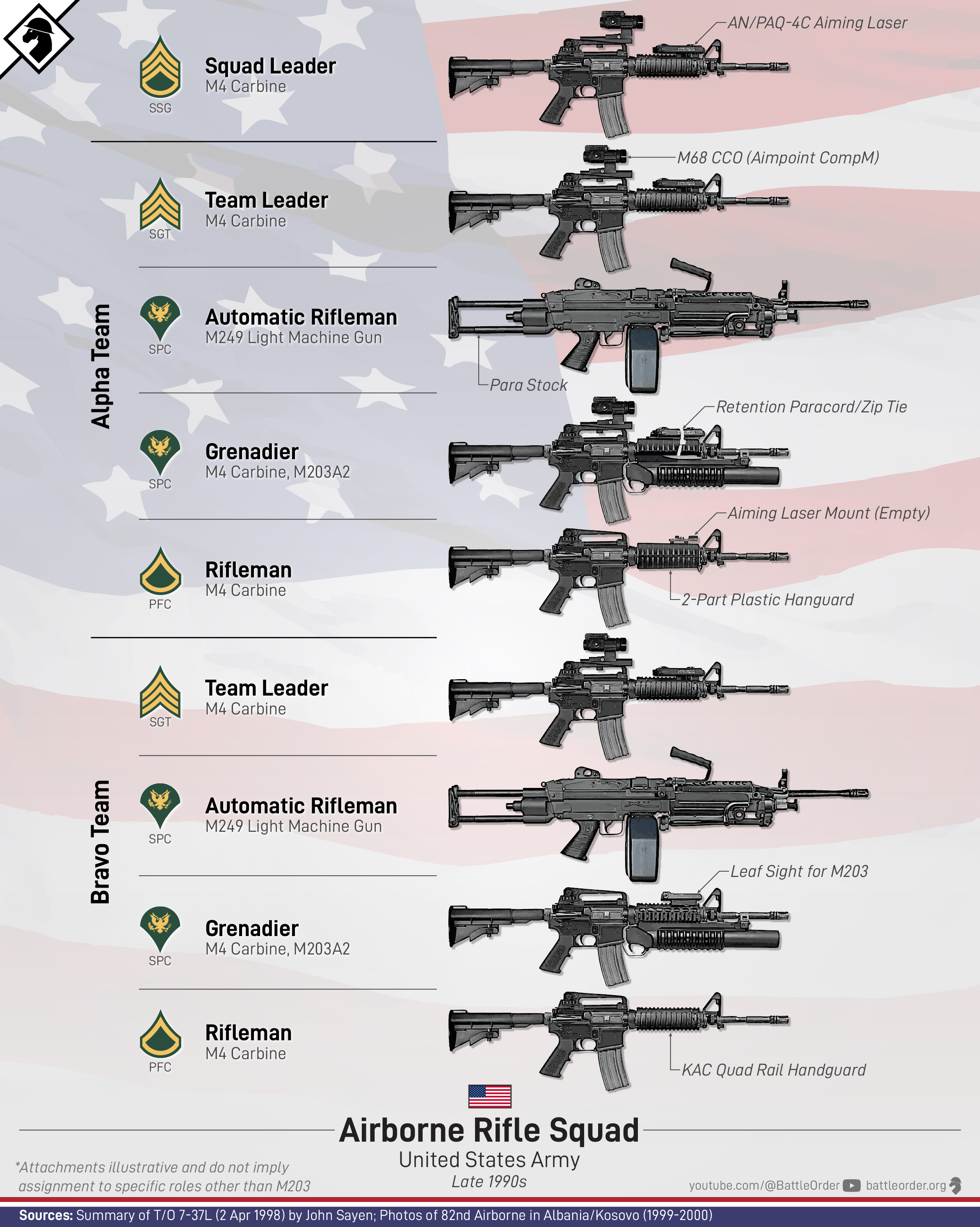
The late 1990s was a key step in the evolution of U.S. Army infantry equipment, as depicted in this graphic of the Airborne (and Air Assault) Infantry Rifle Squad from that period.
The current 9-man squad had replaced the 11-man squad as a means of reducing manpower requirements a decade prior under the Army of Excellence (AOE) (Sayen, page 287), so nothing new there. However, what was new was the M4 Carbine. For the most part the M16A2 was still the standard TO&E in infantry units, except for certain carbine-authorized positions such as like officers, First Sergeants, Platoon Sergeants, RTOs, mortar teams and Javelin gunners. In Airborne, Air Assault, and Ranger Battalions though, the M4 Carbine replaced the M16A2 in Rifle Squads in the mid/late-1990s.
The structure was the same as it was from AOE to today: 9 soldiers, 1 Squad Leader (Staff Sergeant) and two Fire Teams consisting of a Team Leader (Sergeant), Automatic Rifleman, Grenadier, and Rifleman. What was interesting was their setups. The late 1990s was a transitionary period for U.S. Army infantry equipment. The setups on the graphic are based on photos of the 82nd Airborne Division's deployments to the Balkans in 1999-2000. The M4 Carbine was already ubiquitous in this unit and the Automatic Riflemen were mainly armed with M249s with a para stock, standard barrel, and no rail for optics. The gradual introduction of the M4 Carbine and its flattop rail in the special-adjacent infantry types was one thing, but this was also the period that the conventional force would get its first taste of optics-for-all, aiming lasers, and quad rail handguards for attachments.
Below is a gallery of paratroopers from the 82nd Airborne during operations in Albania and Kosovo from 1999 to 2000.
April 1999, Rinas, Albania. April 1999, Rinas, Albania April 1999, Rinas, Albania June 1999, Gjilan, Kosovo Jan 2000, Vitina, Kosovo June 1999, Kosovo June 1999, Kacanik, Kosovo
There was a mix of attachments or lack thereof as this was after the Army started procuring some new toys. For one, there is a visual mix of the classic 2-part plastic handguard and new Knights Armament Company (KAC) quad rail handguards. From the signing of contracts on 9 August 1997 to 22 July 1999 KAC delivered 1,000,000 rail adaptor systems (RAS) to the U.S. Army (TheFull9 2022). This provided mounting options for new attachments, such as the AN-PAQ-4C aiming laser (although this could be mounted to the plastic handguard with a bracket during this period). In the first photo of two soldiers staring longingly in the distance the one on the left has their aiming laser mounted this way (with only the top piece of the handguard to accomodate the M203) while the one on the right has an empty bracket mounting bracket.

Secondly, somewhat confoundingly, when paratroopers were seen with the new M68 CCO (the Aimpoint CompM at the time) they were mounted on a rail adaptor on top of the carry handle despite the M4 Carbine having an integral rail. This made for quite the height over bore. While I haven't seen this written down anywhere (I admittedly haven't looked that hard), I believe this may be because the backup iron sight (BUIS) was a SOPMOD attachment that hadn't proliferated to conventional units, so the carry handle was the backup sight. Rangers got SOPMOD attachments during this period, like BUIS, forward handgrips, and the Trijicon ACOG (seen pictured). Thus, when optics were rail-ready they could use them with the rail (although there were still carry handle-mounted optics in use by the Rangers). The M68 CCO on the otherhand was a separate thing.

In 1997, the U.S. Army adopted the first M68 CCO, the Aimpoint CompM XD, of which 100,000 were delivered before switching to the CompM2 starting in 2000 (Blish). This means the optics that the 82nd Airborne deployed to the Balkans with were still brand new. The M4 itself only started being issued to light units in 1995 at the earliest (White, Infantry, Vol. 84, No. 4, page 2), so the entire setup was quite novel, even if the 75th Rangers had it slightly fancier. By the time the 21st century rolled around the 82nd was mounting optics more sensibly though. Note how in this photo of 82nd Airborne paratroopers in 2002 how they are using backup iron sights and mounting their CCOs normally.







Comments