


U.S. Army Parachute RIfle Platoon Graphic (Feb 1944)
May 4
2 min read
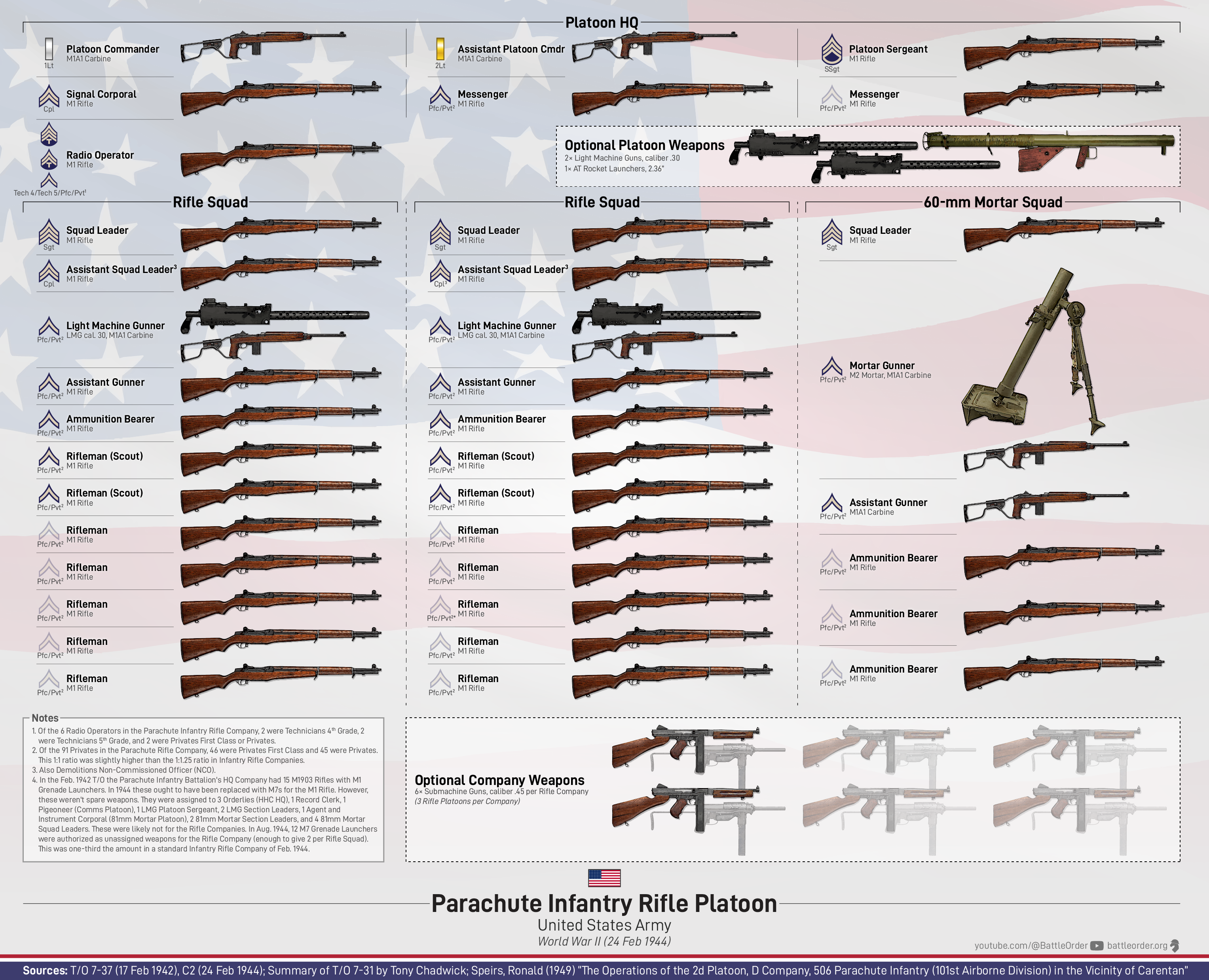
The U.S. Army Parachute Infantry Rifle Platoon from February 1944, the TO&E active for the Battle of Normandy.
The effects of airlift economy can be seen in this organization. Unlike in the regular infantry, the Parachute Rifle Companies had no Weapons Platoon (typical operators of 60mm mortars and M1919A4 LMGs). To compensate for this, M1919A4 LMGs were issued to Rifle Squads instead of M1918A2 BARs and 1 spare M1919A4 was authorized for each squad. Each Rifle Platoon also had a 60mm Mortar Squad. The M1918A2 was authorized for a Rifleman in the lead up to Operation Varsity (1945), although it was unofficially carried before then. The Rifle Company also had 6 submachine guns in reserve to issue at commander's discretion. I show 2 SMGs highlighted just to suggest that there are 3 Rifle Platoons, but these could be distributed in any manner and they more than likely had more than just 6 per company.

Until the December 1944 TO&E implemented before Operation Varsity, Parachute Rifle Platoons only had 2 Rifle Squads officially (although 3 were implemented after D-Day and before Varsity by combat experienced units). This allowed a Rifle Platoon to be carried in just two C-47s, but left a fragile platoon structure. Pictured here is Ronald Speirs’ platoon before the fighting around Carentan from 11-13 June 1944 (2d Platoon, Company D/506 PIR). It shows on and shortly after D-Day he lost 58% of his men, including all of his leadership and almost his entire 2nd Squad. They lost their 60mm mortar on the jump and only had enough men to operate 1 LMG as riflemen were a higher priority in the hedgerow fighting.
At this time each platoon was also authorized two officers, one Platoon Commander (1LT) and one Assistant Platoon Commander (2LT) which provided one officer per plane for redundancy. In Band of Brothers (E/506 PIR) terms, on D-Day:
1st Platoon - 1LT Richard Winters assisted by 2LT Harry Welsh. Winters was de facto XO as that position was vacant
2nd Platoon - 2LT Warren Roush (injured on D-Day and made 3rd Platoon Commander) assisted by 2LT Lynn “Buck” Compton
3rd Platoon - 1LT Raymond Schmitz (injured before D-Day wrestling Winters) assisted by 2LT Robert Matthews (KIA on D-Day) leaving Staff Sergeant Carwood Lipton as the only original leadership






Comments